
Published on:
Ahmedabad I Folklore that binds the geography
Stories attached to places, names and corners of a city I thought I knew.
Ahmedabad I Folklore that binds the geography
Fascination is a strange thing. It makes you look at something familiar and suddenly realise you don’t know it at all. Kahani (story) has always been around us. There are folklores you grow up listening to, forming your own little perceptions of things, and there are stories that make you a central protagonist in the plot. Here, I was curious about the city I am from, with an itch to know it further. After all, when asked where you are from, there has to be an answer that really makes you aware of the spark you carry, right?
Folktales or lores; associations and names of a geographical existence are the lens I would be narrating these stories from. There are many versions of these stories, yet this is the version that I am aware of; so here they are: the city that raised me for almost two and a half decades, the stories that Ahmedabad remembers.
Lore no. 01 I Mystic who wove a city (Manek Chowk)
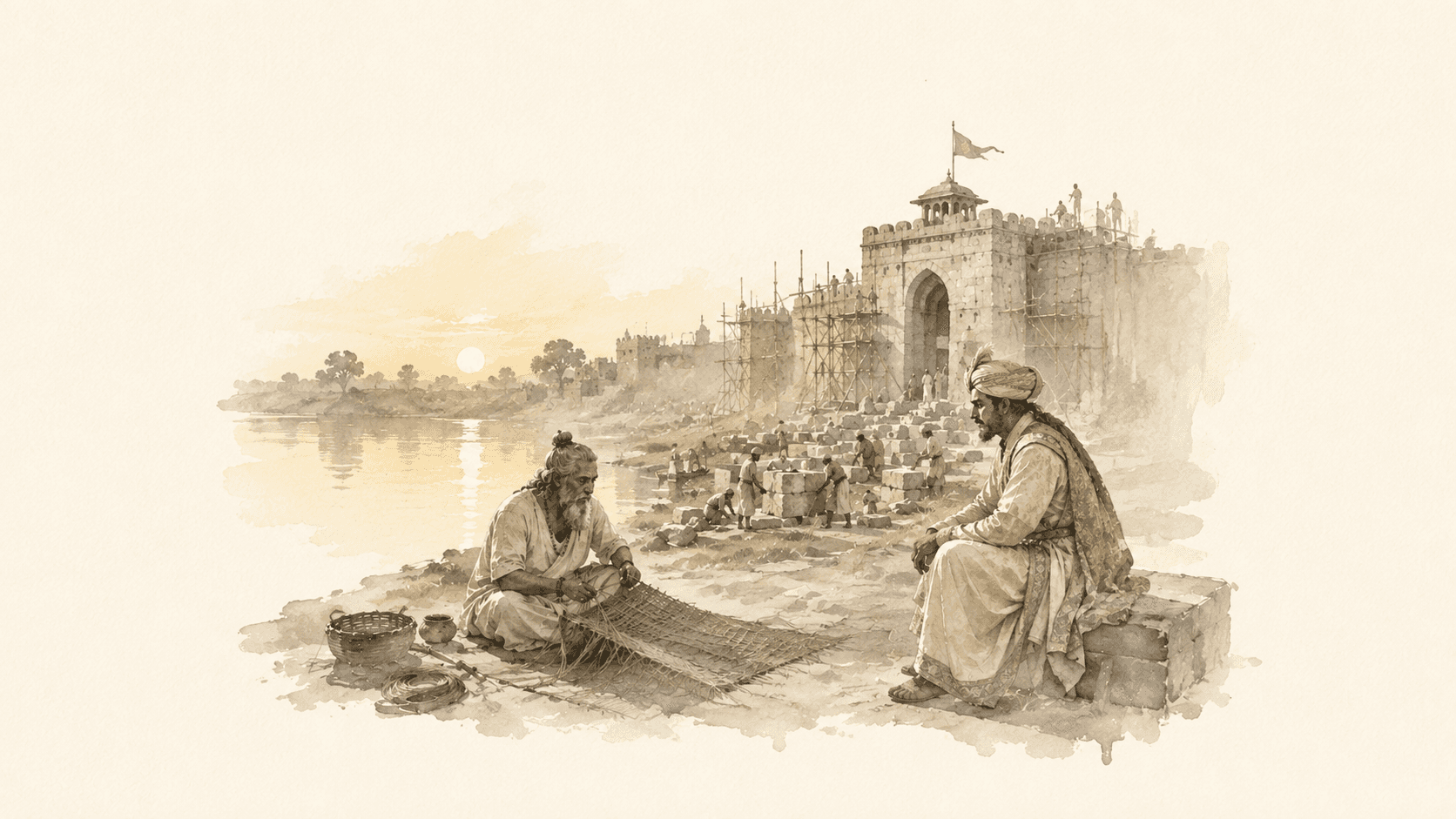
Long ago, before Ahmedabad was even a city, a mystic named Maneknath lived by the banks of the river Sabarmati. Around him, a new city was in the making. Sultan Ahmed Shah had just begun building his fort, and every day the masons worked patiently, laying stone upon stone. Yet something curious kept happening. By morning, the walls they had built seemed to have lost their strength and would come down. Again, the masons would build, and again the wall would come down the next day. People began wondering; then they noticed Maneknath. The mystic would sit quietly by the river, weaving a mat. His hands moved gently through threads - pulling, joining, weaving, and unweaving. It was said that as he unravelled his mat, the walls of the fort too unravelled with it. For several days, the strange rhythm continued: the city was built by day and woven apart by night. When Ahmed Shah heard of the mystic, he went to meet him.
What followed was less a hierarchical dispersal and more two remarkable minds meeting. The Sultan asked Maneknath to demonstrate his powers, and the mystic agreed. The Sultan wished for him to enter a small vessel through a narrow opening. Once the mystic entered, the Sultan sealed it with a cork. This brought their curious encounter to an end. But Ahmed Shah did not let the mystic disappear from the story of the city.
The gadh (bastion) or the foundation stone came to be known as Manek Burj, and the great marketplace nearby as Manek Chowk. Centuries later, the city still carries the name of both men; One built with stone, one wove with thread.
Lore no. 02 I Rabbit of Ashaval
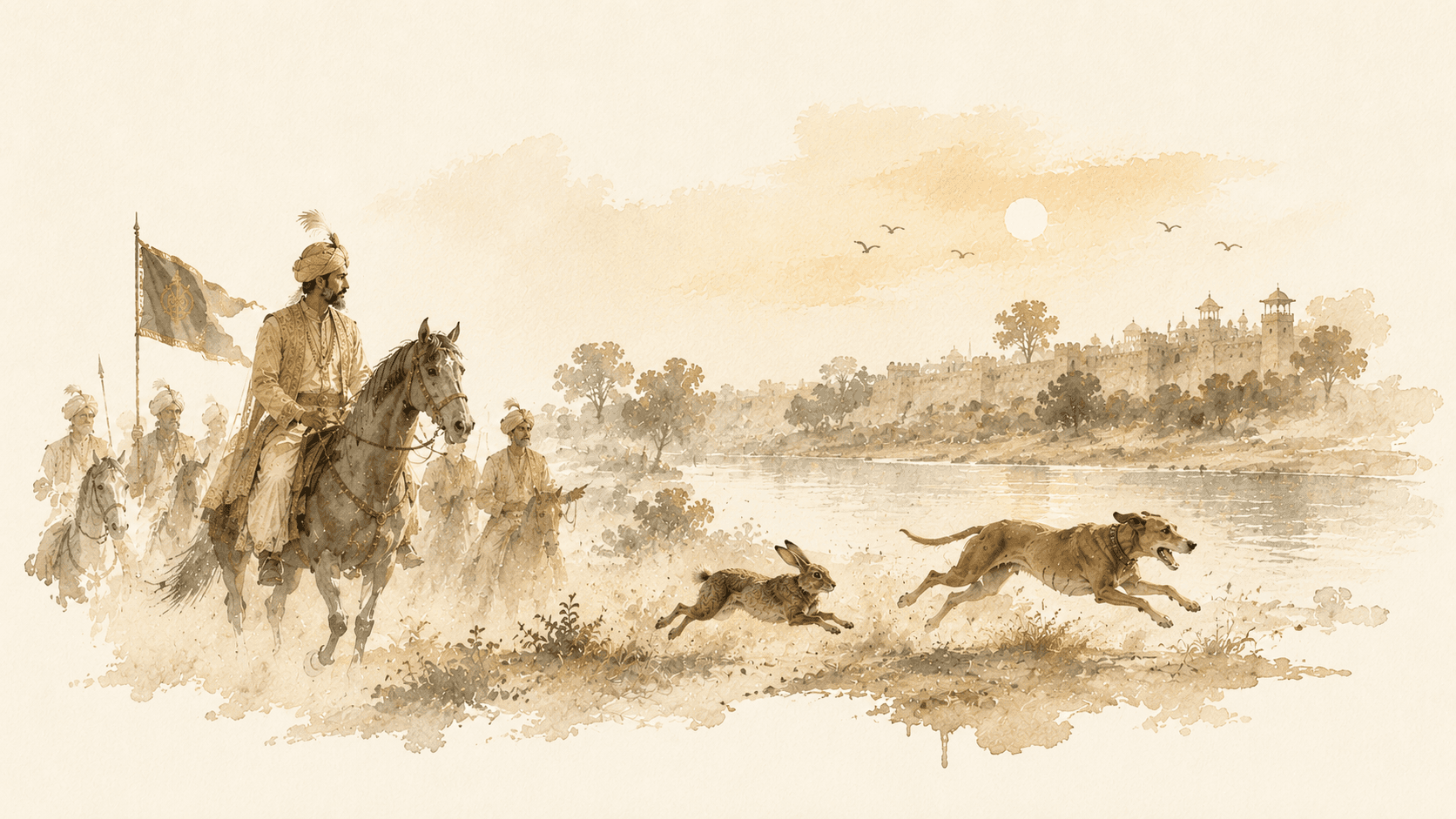
Before Ahmedabad had a name, the banks of the Sabarmati were known as Ashaval. The legend places the story in 1411: Sultan Ahmed Shah was travelling through the region. One day, while hunting with his companions, he came across a strange sight. A hunting dog was being followed by a small hare. Instead of running away, as a hare normally would, it turned towards the hound and chased it.
Ahmed Shah stopped to watch. The sight surprised the Sultan. How could such a small and gentle creature show such courage? He turned to his advisor and asked the question. The answer became the heart of the legend: perhaps this was the land, a place that could give even the timid the courage to face the mighty. The Sultan was already searching for a new capital. Perhaps, he thought, this was the place.
So the story says that he chose the banks of the Sabarmati, at the old settlement of Ashaval, as the site for his new city. The foundation of Ahmedabad was laid in 1411, at Manek Burj.
A simple saying: “Jab Kutte par sassa aaya, tab Badshah ne sheher basaya.” meaning, when the hare chased the dog, the king built the city. [Edalji Dosabhai’s 1894 account]
Lore no. 03 I Sage who gave his bones
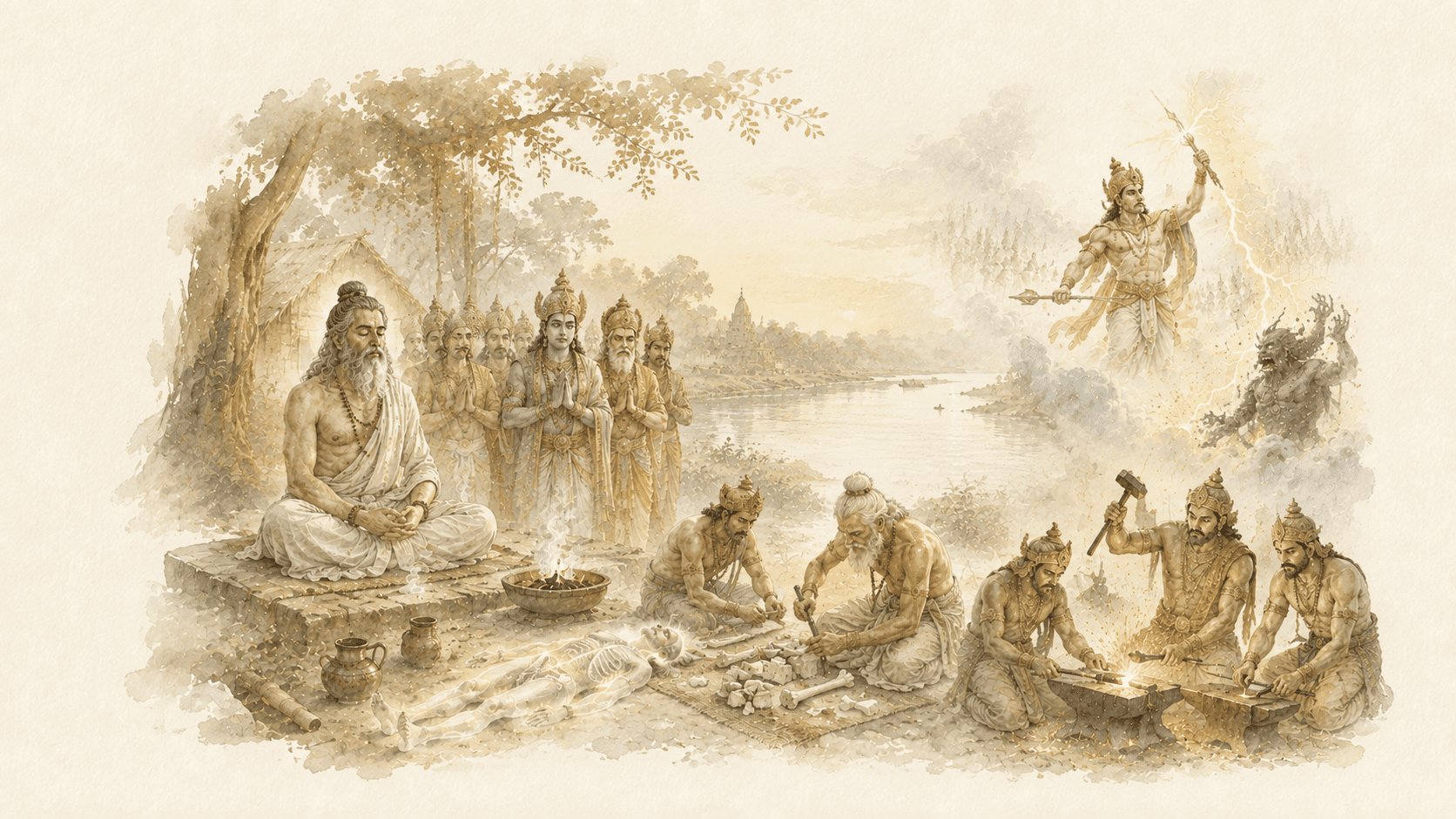
Long before Ahmedabad had its walls, markets, or gates, the banks of the Sabarmati were believed to have been home to a great sage, Dadhichi. He lived at his ashram near what is now Dhudheshwar, spending his days in prayer and meditation. Then came the great battle. The gods were fighting the asuras, but the powerful demon Vritra couldn’t be defeated by ordinary weapons. The gods turned to Dadhichi for a powerful weapon to defeat him. They asked for something extraordinary from him: his bones.
From them, they could forge the Vajra, the thunderbolt weapon of Indra, king of the gods. Dadhichi understood what was being asked of him, and he agreed. The sage gave up his own life; the Vajra was made; the weapon was used by Indra on Vritra; and the gods prevailed. The story is remembered at Dudheshwar, also known as Dadhichi Tirth, on the Sabarmati. Centuries later, when Mahatma Gandhi moved their ashram from Kochrab to Sabarmati in 1917, the connection was still part of the memory of the land. (The official history of Sabarmati Ashram notes the site’s mythological association with Dadhichi’s ashram.)
Lore no. 04 I The flame that never went out
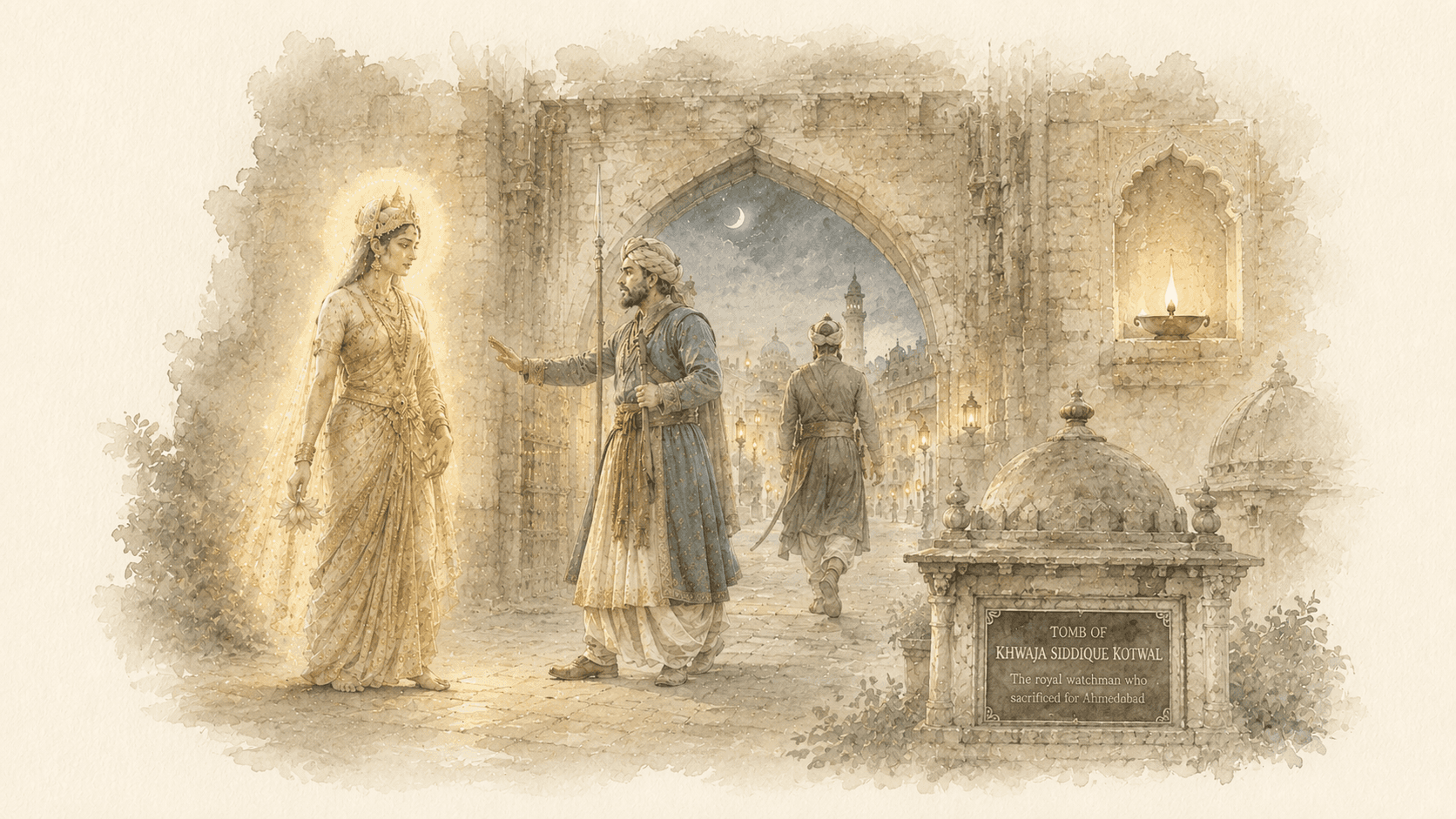
There is a small flame kept within Teen Darwaza, one of Ahmedabad’s oldest gateways. Long ago, late one night, Lakshmi Ma, the goddess of wealth and prosperity, came to the gates of Bhadra Fort. She was leaving Ahmedabad.
The royal watchman, Khwaja Siddiquie Kotwal, saw her and asked who she was. “I am Lakshmi; I am leaving the city.” Siddique Kotwal understood what her departure would mean for the city. He asked her to wait while he went to seek permission from Sultan Ahmed Shah. Lakshmi Ma agreed.
But as he went to the Sultan, he realised that if he returned with permission for her to leave, Ahmedabad might lose its prosperity forever. So, he made a sacrifice for the city. He beheaded himself, ensuring that he could never return to give Lakshmi Ma permission to leave. And Lakshmi Ma kept her promise. She stayed.
Her presence brought prosperity to Ahmedabad, while Siddhique Kotwal’s sacrifice became part of the city’s memory. The old city still carries traces of the tale: near Bhadra Gate stands the tomb associated with Siddhique Kotwal, while within a niche of Teen Darwaza, a lamp is traditionally said to keep burning in memory of Lakshmi Ma and the sacrifice. This tradition has been passed through generations of a Muslim family. It’s a promise that Ahmedabad has kept alive.
Lore no. 05 I Dream that travelled from Puri
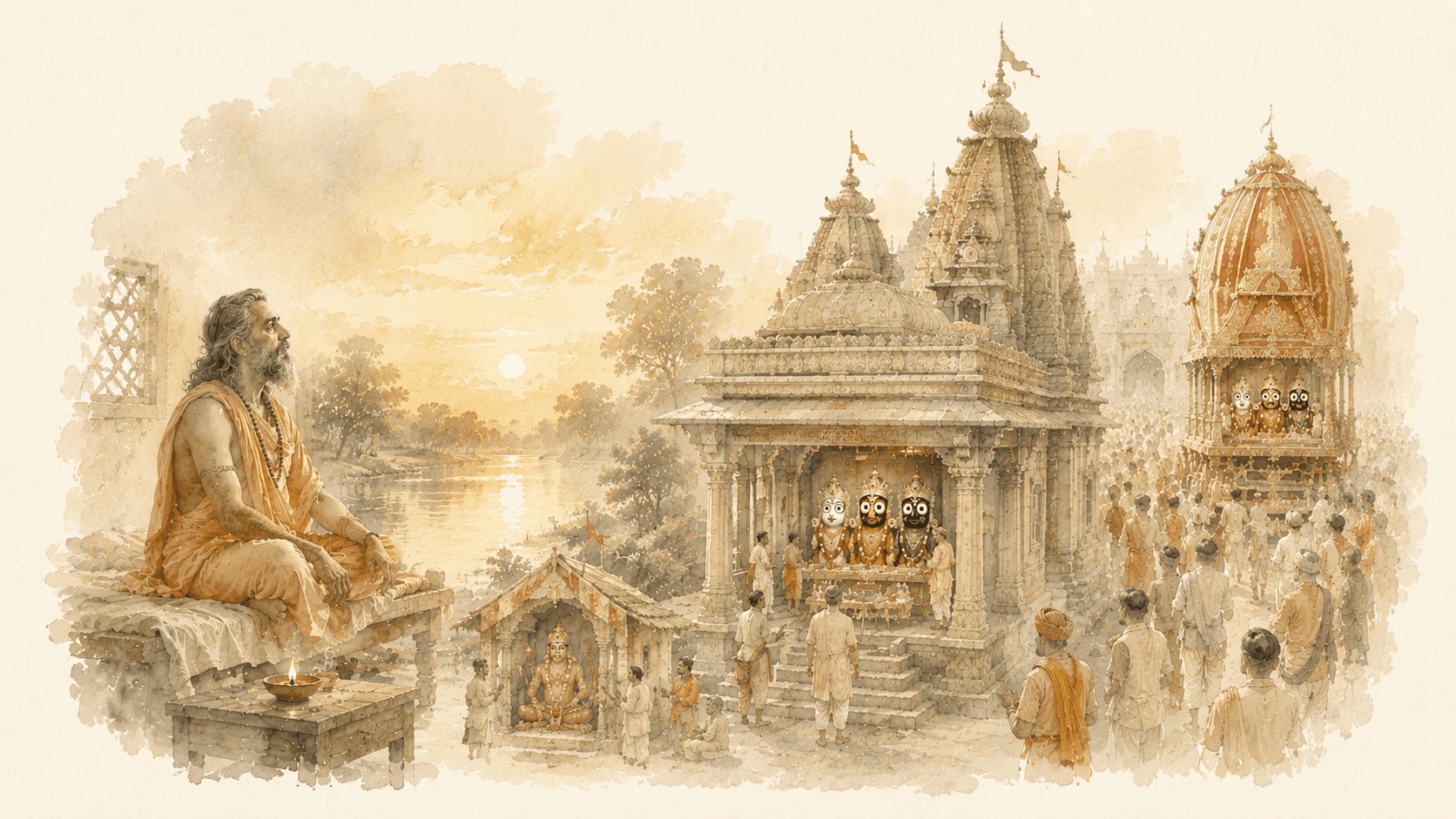
About four and a half centuries ago, the place where the Jagannath Temple stands in Jamalpur now was very different: a quiet forest stretch beside the Sabarmati, at the edge of the city. A sadhu named Shree Hanumandasji came here seeking a place of solitude. A devotee of Hanuman, he made this peaceful spot his home and placed an idol of Maruti.
Over time, people from surrounding areas began coming to the little shrine. What began as a simple place of prayer slowly grew into a temple. Then came his successor, Shree Sarangdasji.
Sarangdasji was a devotee of Lord Jagannath, and he longed to visit the great Jagannath Temple at Puri. So, he travelled east to Puri. One night, while staying in the dharamshala of the Jagannath Temple, he had a dream.
In the dream, Lord Jagannath appeared before him and asked him to return to Ahmedabad and place three sacred deities - Jagannath, his elder brother Baldevji, and their sister Subhadraji.
Sarangdasji returned to Ahmedabad, and the shrine of Hanumanji became the shrine to Jagannath. The temple that stands there today grew. The story did not remain inside the walls, and in 1878, the Rath Yatra began from Jamalpur, following the tradition of Puri. Even today, it travels through the old city before reaching Saraspur.
Lore no. 06 I Goddess inside the Sultan’s fort
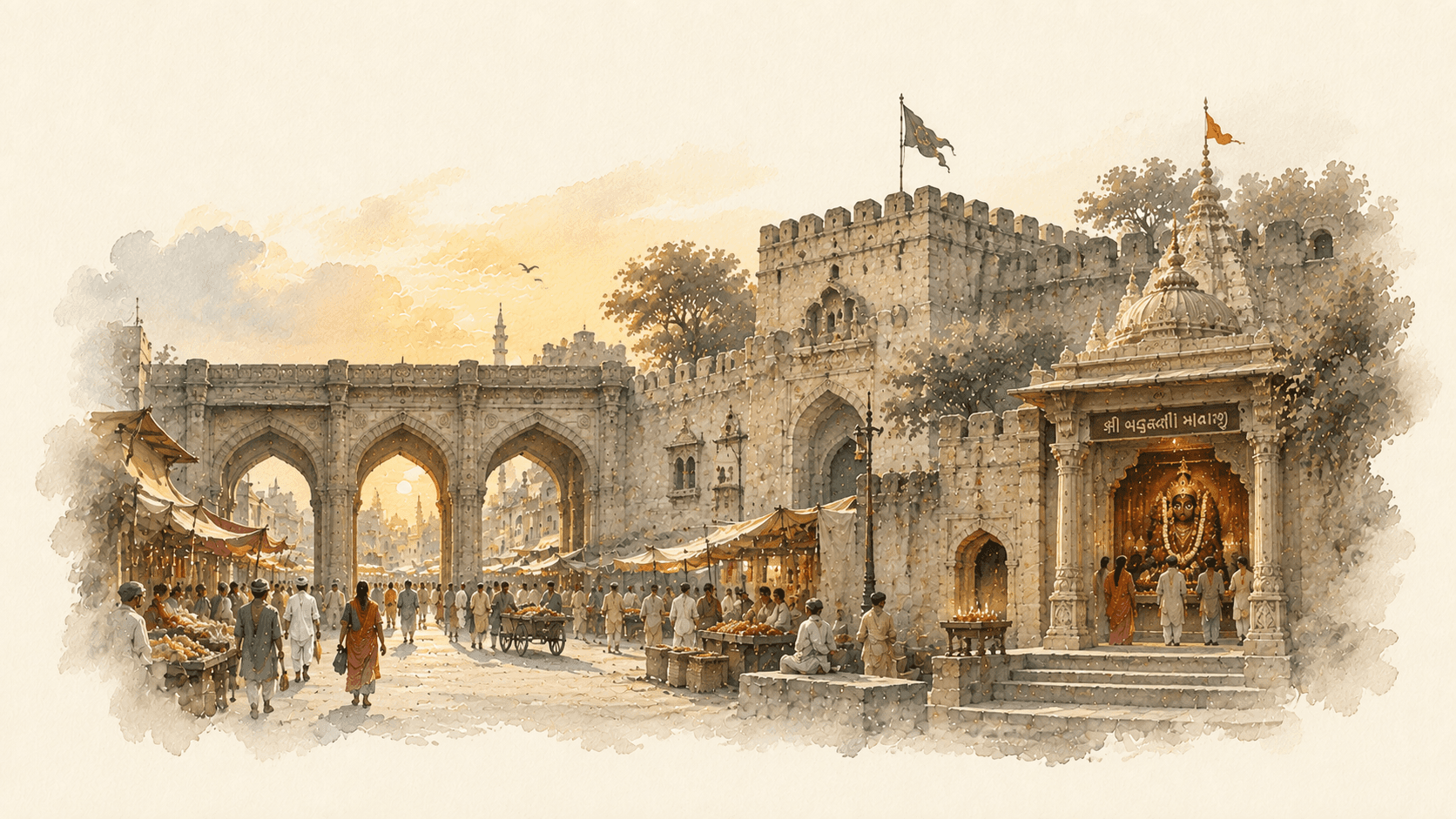
Walk into Bhadra Fort, and somewhere among the old stone arches and busy streets you find a temple. Inside the Sultan’s fort sits Ma Bhadrakali. It is a curious place for a goddess.
The fort was begun by Sultan Ahmed Shah in 1411. Over the centuries, rulers changed; then came the Marathas and then British rule. The fort changed, and Ahmedabad changed with it. The Bhadrakali Temple that stands within the fort today belongs to a later period, associated with Maratha rule. Yet the goddess becomes deeply woven into the identity of the place.
Local tradition remembers Bhadrakali as a guardian of Ahmedabad. Her shrine remained within the heart of the old city, surrounded by markets, gateways, and streets that grew around Bhadra.
A Sultan’s fort. A Hindu goddess. A marketplace that never seems to sleep. All gathered within the same few hundred steps. There is even a little mystery in the name. Today, Bhadra is closely associated with the Bhadrakali temple inside the fort. (Ahmedabad’s heritage records). Although the temple itself belongs to a much later period, associated with Maratha rule, the name Bhadra was inherited from the ancient Rajput citadel at Anhilwad-Patan. (UNESCO’s historical account)
So, when you enter Bhadra Fort, you are entering the first citadel of Ahmedabad: a Sultan’s fort. A place where centuries of the city have gathered around. Walls changed, rulers changed, the city changed; the goddess stayed at its heart, a name older than both.
Lore no. 07 I The tree carved in stone
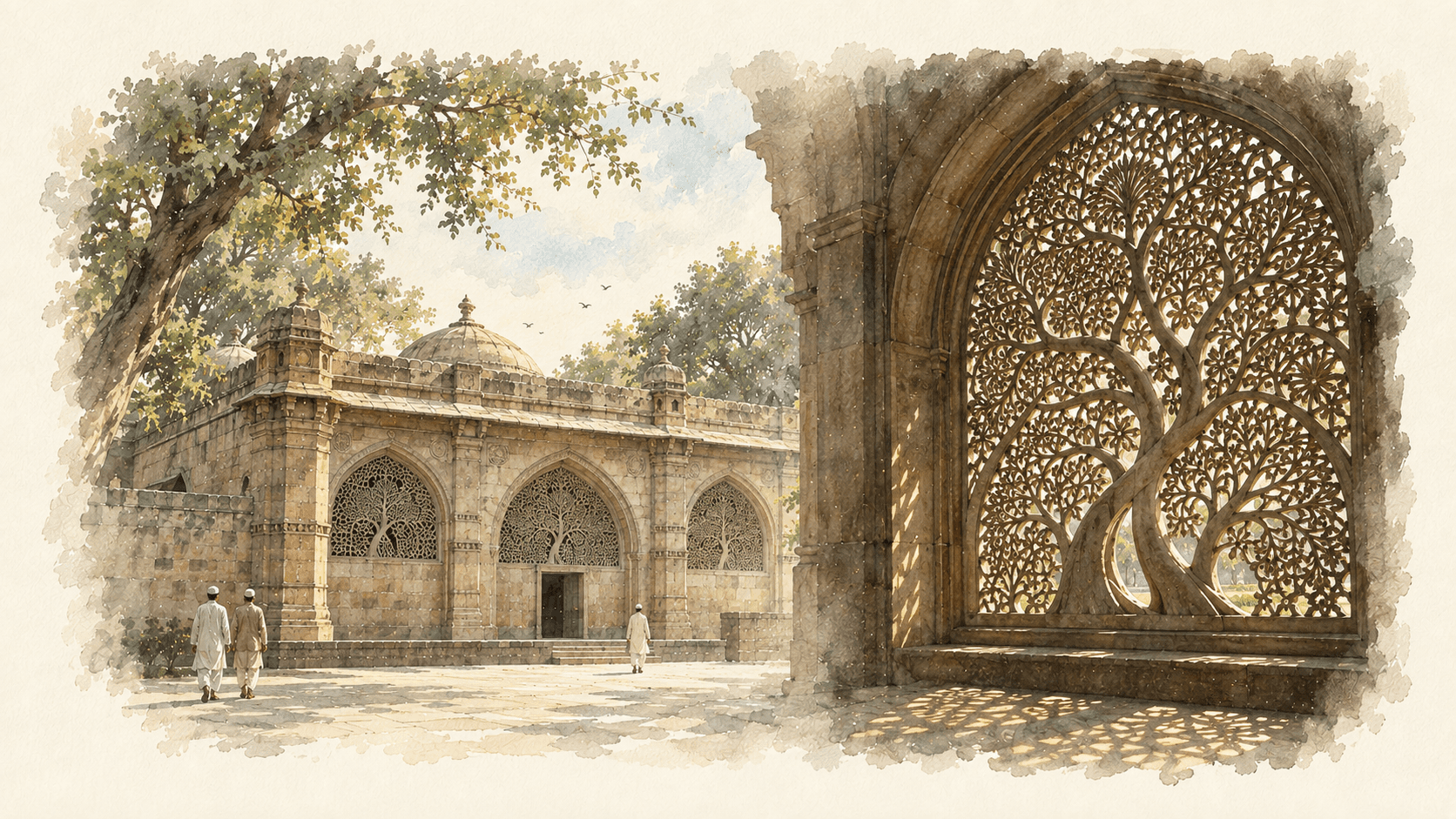
At the edge of the old city, near Lal Darwaza, stands a small mosque: Sidi Saiyyed Mosque. It was built in 1572–73, in the final years of the Gujarat Sultanate, by Sidi Saiyyed, an African-origin nobleman who had risen to prominence in Gujarat. From outside, the mosque is modest, but look through one of the windows.
There, in a single piece of stone, a tree begins to grow. Branches twist and cross one another; leaves unfold in stone. The whole screen looks almost like lace, it is the famous Tree of Life jali. No separate pieces, no paint, just stone carved so finely that light passes through it. The mosque has ten stone lattice screens, but the central arch remains without its expected jali, likely because the mosque was left unfinished around the time the Mughals took Gujarat. And this little piece of Ahmedabad travelled far beyond the mosque.
The Tree of Life became one of the enduring symbols; the form was later adapted for the IIM Ahmedabad logo, and its image appears wherever Ahmedabad is remembered and represented. It’s a story about something that still grows: a tree that has no soil, branches that have never known wind, and leaves that have never fallen, a symbol of the city.
. . . . . . . . .
Maybe this is what a city does. It tells stories in the name of a chowk, a flame behind the gate, in a temple inside a fort, in a tree carved into stone.
Ahmedabad is full of them. I just haven’t heard them all yet.
A note: This is a collection of local legends, oral traditions, and historical accounts associated with places in Ahmedabad. Some stories exist in more than one version; this is the version I encountered and chose to tell.
Source: hinted.
Ahmedabad Municipal Corporation . Heritage Ahmedabad
UNESCO . Historic City of Ahmadabad
Sabarmati Gandhi Ashram . History of the Ashram
Gujarat Tourism . Heritage sites
Ahmedabad District . Government of Gujarat
Shree Jagannathji Mandir, Ahmedabad . Temple historyBooks / References
Edalji Dosabhai, A History of Gujarat: From the Earliest Period to the Present Time (1894)
M. S. Commissariat, A History of Gujarat
Relevant Ahmedabad heritage documentation and inscriptions
Let’s keep in touch.
Follow us on Twitter and Instagram.
